
Nobody wakes up one morning and decides to move into assisted living.
The decision builds slowly. It starts with small observations. Dad left the stove on. Mom forgot to take her medication. The house feels too big and too quiet. A fall that didn't cause injury but caused a conversation.
For many families and for many elders making this decision for themselves, the time between "I wonder if..." and "we're ready to move" stretches across months and years. Research from Creating Results found that 47% of independent living residents searched for two or more years before moving in. The average senior living lead requires 25 touchpoints before converting.
This is not a sales cycle. This is a life decision with an extended emotional timeline. And most senior living marketing strategies are not built for it.
This post is about the families and elders in that long-consideration. The ones who aren't ready yet, but will be. And what your community can do now to be the trusted name when that moment arrives.
Two audiences, one consideration window.
The long-consideration audience isn't a single group. It splits into two distinct profiles with different emotional needs and different decision-making patterns.
The adult child planning ahead.
Usually 45-60 years old. They're noticing changes in a parent: forgetfulness, mobility decline, increasing isolation, difficulty with daily tasks. They may have had "the conversation" at a holiday gathering or after a minor incident. They're researching in the background, often without telling the parent. They're not ready to act. They may not be ready for six months, a year, or two years.
Their emotional landscape is dominated by guilt, responsibility, and uncertainty. They feel guilty for considering this. They feel responsible for making the right choice. They're uncertain about timing: too early feels premature, too late feels irresponsible. They want permission to explore without commitment.
The elder choosing for themselves.
Usually 70-85 years old. They're thinking about the next chapter. They may be healthy but realistic about what's coming. They want community, less home maintenance, access to care if needed, or simply a living situation that matches where they are in life rather than where they were twenty years ago.
This audience is growing. Data from Senior Housing News indicates that 48% of people researching senior living are searching for themselves, not being researched by an adult child. As Baby Boomers age into the senior living category, this percentage will continue to climb.
Their emotional landscape is fundamentally different from the adult child's. This is about identity, independence, and agency. They're asking: Will I still be treated like an adult? Will I still make my own decisions? Will I still be me in this new place? They are not looking for someone to take care of them. They're looking for a community that respects who they are.
These two audiences need different content, different creative, and different emotional appeals. The adult child needs reassurance and permission. The elder needs respect and agency. Marketing that speaks only to adult children making decisions for aging parents is invisible to nearly half the people actively researching senior living.
The content architecture that builds trust over time.
When someone is 12-24 months from a decision, they don't need your floor plans. They need understanding. They need tools. They need to feel like your community is a trusted resource before they ever need your community to be a home.
Content for long-consideration audiences works in three tiers, each mapped to a different distance from decision.
Tier 1: Furthest from decision (12-36 months out)
These families and elders are in "I wonder if..." territory. They're not comparing communities. They're trying to understand the landscape. They have questions that feel too early to ask anyone directly.
The content that serves them: "How do I know when it's time for assisted living?" is the single highest-value consideration keyword in senior living. Nearly every family in the early stages of this journey types some version of it into Google. If your community has a well-written, honest answer to that question on your website, you're capturing the beginning of a relationship that could convert in 18 months.
Other Tier 1 content: "Assisted living vs. aging in place: an honest comparison." "How to talk to your parent about senior living" (for adult children). "10 questions to ask yourself about your next chapter" (for elders). Caregiver burnout self-assessments. Home safety checklists. "Is it time?" self-evaluation quizzes.
Here is the counterintuitive principle that makes Tier 1 content work: the best content at this stage helps people live better and longer at home.
That sounds like you're working against your own interests. You want them to move in, so why would you help them stay home? Because when your community becomes the trusted resource, when yours is the name attached to the checklist that helped them prevent a fall, the assessment that helped them recognize caregiver burnout, the honest comparison that helped them understand their options, you are the first call when the situation changes. You earn the right to be considered by being useful before you're needed.
Every Tier 1 content piece has a secondary purpose: capturing an email address that enters your nurture pipeline. The guide they download, the quiz they complete, the newsletter they subscribe to, these are the entry points to a relationship that unfolds over months.
Tier 2: Active research (6-12 months out)
These families have moved from "I wonder if" to "I'm looking at options." They're comparing. They want practical information that helps them evaluate.
The content that serves them: "What does assisted living cost in [your state]?" Cost is the question everyone wants answered and most communities avoid putting in writing. Being direct about cost ranges, what's included, what factors affect pricing, and how payment works (including state-specific options like Medicaid waivers, veterans benefits, and long-term care insurance) builds significant trust. The community that helps them understand cost is the community that gets their shortlist.
Other Tier 2 content: "What to look for when touring a senior living community" (this positions your community as the expert guide before they even visit). "Understanding the differences between levels of care." "How to pay for senior living: a family guide." Tour checklists they can print and bring with them.
Tier 2 content should start segmenting based on care level interest. A family researching memory care has different informational needs than an elder exploring independent living. If your content treats them identically, you're missing the chance to demonstrate that you understand their specific situation.
Tier 3: Preparing for transition (0-6 months out)
These families are moving toward a decision. They've narrowed their options. They're thinking about logistics, emotions, and what happens after the move.
The content that serves them: "What the first 30 days in assisted living look like." This is the content that addresses the fear nobody voices directly: what happens after we sign? Will Mom adjust? Will Dad be angry? Will they make friends? Will they be okay?
Other Tier 3 content: "Downsizing checklist: preparing for a move." "How to help a parent adjust to assisted living" (for adult children). "What to expect when you move in" (for elders making the choice for themselves). "Making the transition feel like coming home."
This tier is where your content shifts from educational to reassuring. The decision is nearly made. What remains is the courage to act and the confidence that it will be okay.
The nurture sequence: patience as strategy.
A 25-touchpoint conversion path doesn't happen through content alone. It requires a structured nurture sequence that builds relationship over months without ever feeling like a sales pitch.
Month 1: Deliver the resource they requested. Follow up with one additional piece of related value: "3 things families wish they'd known earlier about senior living." Invite them to your newsletter. That's it. Don't sell. Don't push a tour. You just met.
Months 2-6: Monthly newsletter. Not a sales email. A newsletter that contains resident stories, family caregiver tips, and community event listings. One authentic video per quarter: a real resident or family member sharing their experience, 30-60 seconds, shot on a phone, not over-produced. Seasonal content hooks: "Holiday tips for families navigating senior living conversations" in November. "Spring cleaning as a downsizing opportunity" in March.
Months 6-12: Begin segmenting based on behavior. If they clicked on memory care content, send memory care resources. If they engaged with independent living content, send independent living stories. This is where your email platform should be doing work your team can't do manually.
Introduce low-pressure event invitations. Not "Schedule a Tour." Instead: "Join us for a free Medicare planning seminar this Thursday." "Our monthly caregiver support group meets every second Tuesday. You're welcome." More on this in the next section.
One physical mail touchpoint during this window. A mailed piece stands out when everything else is digital. Not a glossy brochure. Something useful: a printed checklist, a resource guide, a personal note from your admissions director.
Months 12 and beyond: Continue the monthly newsletter. Quarterly personal check-in from admissions. Not a sales call. A relationship call. "I wanted to check in and see how things are going with your family. Is there anything I can help with?" Some of these calls will surface families whose situation has changed. Many won't. Both outcomes are valuable.
The signal shift that changes everything:
Here is the most operationally critical element of the long-consideration playbook. Consideration families become crisis families overnight. Dad falls. Mom gets a diagnosis. A caregiver hits a breaking point. The timeline collapses from "maybe next year" to "this week."
Your CRM needs to detect that behavioral shift. If a consideration lead who has been opening newsletters for eight months suddenly visits your pricing page, views your availability page, or calls your front desk, your system should flag that lead immediately and route them to your crisis response protocol. The nurture sequence is over. This family needs a callback in 15 minutes, not a newsletter next Tuesday.
If your system can't detect that shift, you'll send an email about your spring gardening program to a family that needed an urgent placement conversation yesterday.
The operational bridge: programming as marketing.
This might be the most valuable idea in this entire post, and it has nothing to do with digital advertising.
Your community already has programming. Events, classes, support groups, seminars, social gatherings. The question is whether any of that programming is open to external audiences.
When a consideration family walks through your doors for a caregiver support group, they are not on a tour. They didn't schedule a visit. They came for help with a specific problem. And while they're there, they're seeing your community in action. They're watching how your staff interacts with residents. They're noticing whether residents seem happy, engaged, and cared for. They're experiencing the physical space and the emotional atmosphere firsthand.
That experience is more credible than any ad, any testimonial, any brochure your marketing team will ever produce.
Programming worth opening to external audiences:
Educational seminars: fall prevention, Medicare planning, memory health, estate planning, navigating long-term care insurance. These attract families in active research mode and position your community as a knowledge resource.
Support groups: caregiver support groups, Alzheimer's family support groups. These attract families dealing with the emotional weight of caring for an aging parent. The trust built in a support group setting is deep and personal.
Social and fitness events: holiday meals, concerts, art classes, yoga, water aerobics, tai chi. These attract elders who are curious about community living and want to experience it casually before committing.
Intergenerational programs and volunteer opportunities. These bring younger community members into your facility and create a sense of connection between your community and the broader neighborhood.
The marketing execution:
Promote these events through your social media campaigns (more on this below). Include them in your email nurture sequences. List them on your website event calendar with registration forms that capture contact information. Partner with local hospitals, churches, and community organizations to cross-promote.
Every person who attends a community event and has a good experience is a future referral source or a future resident. And the cost of running these programs is largely operational, since most communities are already doing them. The marginal cost of making them visible to external audiences is primarily marketing effort, not new budget.
Social media strategy: layers, not blasts.
Social media is the primary paid channel for reaching consideration families. They're not Googling "assisted living" yet. They're scrolling Facebook on a Tuesday night after a tough phone call with Dad. They're seeing your ad between posts from friends. Your creative needs to belong in that feed.
The layered approach works because it respects the behavioral timeline of long-consideration audiences.
Layer 1: Awareness (top of funnel)
Target two audiences separately. For adult children: ages 45-65 with interests related to caregiving, senior health, AARP, elder care. For elders: ages 65-80 with interests in retirement, active living, community.
Creative should be values-based, emotional, and non-promotional. This is not the place to sell. This is the place to establish what your community believes.
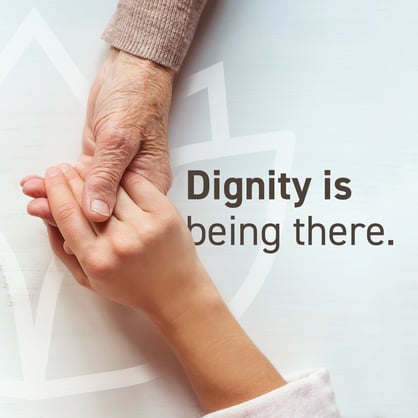
The most effective framework we've seen in senior living social advertising is a values-based campaign. Each ad pairs a single value with an authentic image and a soft call to action. "Dignity is companionship." "Caring is quality time." "Dignity is the little things." The image shows a human moment, not a facility photo. Two people playing cards. A grandparent and grandchild doing a puzzle. Hands held. Coffee in warm hands.
These ads don't convert directly. They build familiarity and emotional alignment over time. A family that sees four or five of these over six months develops a feeling about your community before they ever visit your website.
Goal at this layer: video views, engagement, blog traffic. No conversion ask.
Layer 2: Engagement (middle of funnel)
Target people who engaged with Layer 1 content. Watched 50% or more of a video. Clicked through to a blog post. Liked or shared an ad.
Creative shifts from values to stories. Real resident experiences. Family testimonials. Day-in-the-life content. Community events captured authentically.
Goal at this layer: email capture through a downloadable guide or newsletter signup.
Layer 3: Activation (bottom of funnel)
Target email subscribers, repeat website visitors, and high-engagement leads.
Creative becomes direct but warm. "See what life looks like here. Visit us this month." An invitation to a community event. An offer to schedule a personal visit.
Goal at this layer: event attendance, tour scheduling, phone call.
Layer 1 makes them aware. Layer 2 makes them trust you. Layer 3 makes the ask. Skipping layers is the most common mistake. Communities jump straight to "Schedule Your Tour Today!" with cold audiences. That's a crisis message aimed at a consideration audience, and it bounces.
Creative principles for long-consideration audiences.
The creative that performs best for consideration audiences follows a set of principles that are worth naming explicitly.
People, not buildings. Every image should show a human interaction or a personal object. Hands, not lobbies. Moments, not poses. The ad featuring a grandfather and grandchild working on a puzzle together generated 45+ reactions and multiple organic shares. Families tagged other family members. That's organic reach the community didn't pay for. An exterior photo of the building would have generated nothing.
Values, not amenities. "Dignity is being there" communicates something about who your community is. "24-hour nursing staff on site" communicates a feature. Features inform. Values connect. And consideration audiences are building emotional alignment, not comparing spec sheets.
Consistency over time. A single ad doesn't move a consideration audience. A sustained campaign running the same visual framework over months builds brand recognition and emotional trust. By the time the family is ready to act, your community isn't a name on a list. It's the one that already felt right.
Different appeals for different audiences. Content aimed at adult children should address their emotional needs: reassurance that they're making a good choice, permission to explore, evidence that other families have navigated this well. Content aimed at elders should address their emotional needs: respect for their autonomy, recognition of their identity, assurance that moving doesn't mean losing independence.
The honest budget conversation.
Adding budget to consideration campaigns will not produce immediate move-ins. This is the single most important expectation to set with your leadership team.
Crisis spend generates measurable cost-per-inquiry and cost-per-move-in within 30-90 days. Consideration spend generates pipeline that converts over 6-24 months. These are not the same investment, and they cannot be measured on the same timeline.
When occupancy is stable and the priority is building pipeline for the future: 60-70% of digital budget should flow to the consideration playbook. When census is down and beds need filling: that ratio inverts, with 60-70% going to crisis campaigns.
But consideration spending should never go to zero, because that's how communities end up in perpetual crisis mode. No pipeline means no future move-ins that weren't urgent. And urgent move-ins alone don't sustain stable occupancy.
For communities planning a new wing or new campus opening, the timeline looks like this: start 12+ months out with 80% consideration spending to build awareness and capture interest. Shift to 50/50 at six months as you build toward opening. Shift to 70% crisis at opening to drive move-ins against real inventory.
What should always be running regardless of budget split:
A Google Search campaign for urgent keywords. This is your floor. Even when consideration is the priority, crisis families are searching today, and you should be present.
Social retargeting for website visitors who didn't convert. Whether they came through a crisis search or a consideration blog post, bringing them back costs very little and closes gaps that would otherwise leak leads.
Measuring what matters (and being patient about it).
Crisis metrics and consideration metrics require different dashboards and different review cadences.
Crisis metrics (review weekly): Speed to lead. Call answer rate. Inquiry-to-tour conversion. Tour-to-move-in conversion. Cost per move-in.
Consideration metrics (review monthly or quarterly): Cost per lead. Content engagement rates (time on page, pages per session, return visits). Email open and click rates. Newsletter subscriber growth. Event attendance. Return visitor percentage. Pipeline value (total leads in nurture, segmented by stage).
The unified metric: Cost per move-in by source, measured at 30, 90, and 180 days. This is the number that connects both playbooks to occupancy outcomes. A crisis lead that converts in 14 days and a consideration lead that converts in 14 months both show up here, but at different time windows.
The discipline required: not judging consideration campaigns by crisis timelines. A blog post that generates 50 email subscribers this month might generate 3 move-ins over the next 18 months. That math works. But only if you're patient enough to let the pipeline mature and sophisticated enough to track attribution across a long decision cycle.
What you can do this week.
Write one Tier 1 blog post. Answer the question "How do I know when it's time for assisted living?" with honesty and empathy. This is the single highest-value piece of content you can create for your consideration audience.
Open one program to the public. Pick an event, a class, or a support group your community already runs. Promote it to external audiences through social media and community partnerships. Bring consideration families through your doors for a reason other than a tour.
Audit your email nurture. If you don't have one, start with a simple monthly newsletter. If you have one, ask: does it feel like a relationship, or does it feel like a sales sequence? Would you stay subscribed to it if you were a family member in the early stages of exploring options?
Set up behavioral triggers in your CRM. At minimum: flag any lead who visits your pricing page or availability page after being in your nurture sequence for 30+ days. That behavioral shift is a signal that their timeline has accelerated, and your response needs to accelerate with it.
Run a Layer 1 social campaign. Values-based creative. No conversion ask. Target both adult children and elders in your geographic area. Budget it modestly and commit to running it for at least three months before evaluating. One week of data tells you nothing about a two-year decision cycle.
The long-consideration playbook is about earning trust over time with families and elders who aren't ready yet but will be. It requires patience, consistency, and the willingness to be useful before you're needed. The communities that do this well don't just fill rooms. They build reputations that fill rooms for years.
This post is adapted from a presentation given at the Ohio Assisted Living Association Annual Conference. For the full playbook, including the companion piece on crisis search strategy, visit deksia.com/senior-living-playbook.